Shift Rosters & Payroll for Textile Factories in Pakistan
In cities like Faisalabad, where textile is the backbone of the economy, many units still manage all of this on registers and spreadsheets. Here is a practical way to bring order to it.
The usual problems
A better way, step by step
Define your shifts once
Create each shift (for example, Morning, Evening and Night) with its start time, end time, break and grace period. Every rule is then applied the same way to every worker.
Group workers by department or line
Put workers into shift groups such as Weaving, Spinning, Stitching or Packing. Instead of scheduling 400 people one by one, you schedule a few groups.
Publish a monthly roster
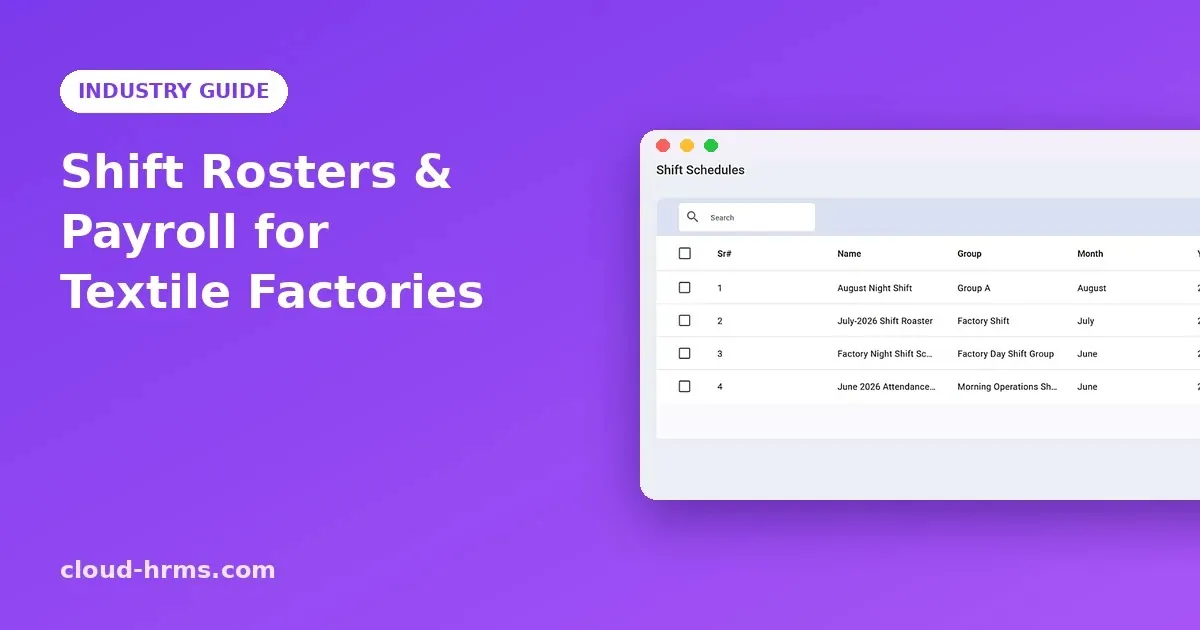
Assign each group to its shifts for the month, including rotations. Workers and supervisors can see the roster in advance, so there is no confusion at the gate.
Record swaps and overrides in the system
When a worker covers someone else’s shift, record it as an override. Attendance and payroll then follow what actually happened, not what was planned.
Capture attendance at the gate with biometrics
A biometric machine at the factory gate records every check-in and check-out against the worker’s assigned shift, so late arrivals, early departures and overtime are calculated automatically.
Let payroll read from attendance
When attendance, overtime, leaves, advances and loans are all in one system, salaries for every department can be generated in one step, along with bank transfer files and payslips.
What changes for the factory
How Cloud HRMS helps textile and manufacturing units
Cloud HRMS includes shift definitions, shift groups, monthly shift schedules and override shifts, connected to ZKTeco biometric attendance and one-click payroll. Its mobile app works in Urdu, so factory staff can check their schedule, apply for leave and download payslips without visiting the HR office. And because our support team is based in Faisalabad, we can visit your unit to help set it up.
Run a textile or manufacturing unit?
Book a free demo and see your own shift rosters running smoothly in Cloud HRMS.